Buying a Street Lamp for an international project involves more than comparing prices and appearances. Buyers must connect technical performance with local conditions, installation practices, and long-term maintenance. A lamp that performs well on a showroom floor may struggle beside a humid coastline, a dusty highway, or a freezing industrial road.
This guide presents ten practical buying tips for global purchasers. It considers light distribution, wattage, color temperature, housing materials, IP and IK ratings, controls, certifications, warranty terms, and supplier reliability. These details affect safety, energy use, visibility, and replacement costs. Ask suppliers for photometric files, test reports, installation guidance, and clear product specifications. Do not rely only on attractive product images.
Field experience also shows that the cheapest quotation is rarely the complete cost. Freight, poles, brackets, wiring, inspection, and future repairs can change the final budget. A sample test is valuable. Place the Street Lamp in a realistic outdoor setting and observe glare, shadows, brightness, and mounting stability at night. Small details matter.
Some buyers still overlook maintenance access. That mistake becomes expensive. Others choose a high color temperature because it appears brighter, then discover uncomfortable glare for drivers and residents. Requirements may also vary between countries and project owners. Confirm them with qualified local professionals and recognized testing bodies. No checklist replaces careful judgment, but a structured review can prevent avoidable decisions and support a more dependable global purchase.
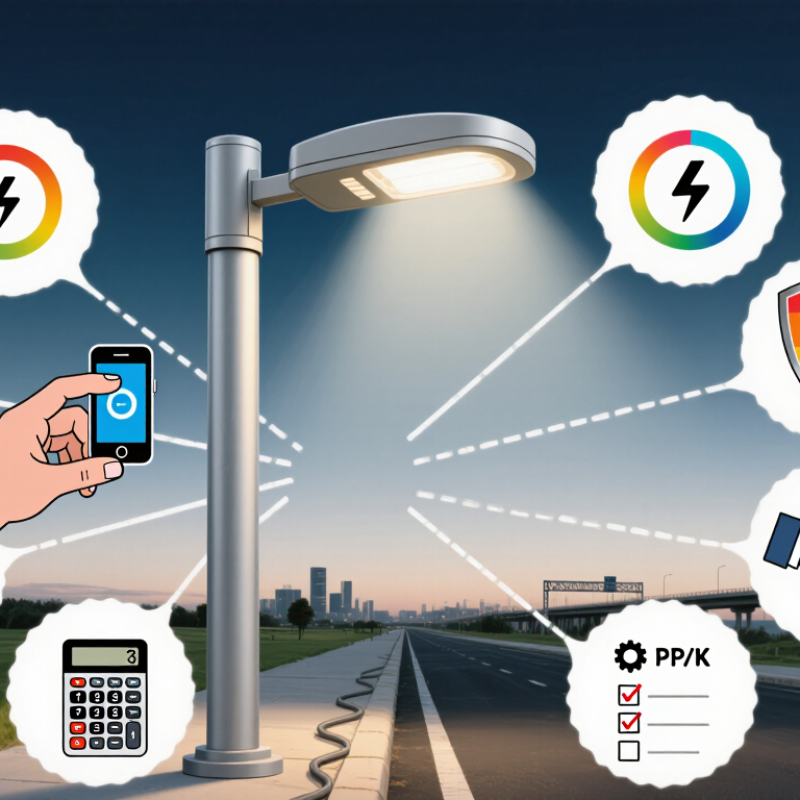
Roadway lighting starts with the street, not the product catalog. Measure lane width, traffic speed, pedestrian activity, and mounting height before selecting fixtures. A narrow residential road needs different distribution from a wide arterial route. Start with the road.
For most outdoor roads, a 3,000–6,000 K correlated color temperature offers a practical balance. Warmer light can reduce visual harshness near homes and parks. Cooler light may improve perceived contrast at crossings, but excessive blue content can create discomfort and unwanted glare. Choose the lowest CCT that still supports visibility, wayfinding, and local environmental needs.
Target LED efficacy between 100 and 200 lm/W, but do not judge efficiency from the datasheet alone. Ask for tested lumen output, optical distribution, temperature ratings, and maintained performance. A fixture producing 160 lm/W may underperform if dirt, heat, or aging reduces useful light on the pavement. Photometric files and roadway simulations should confirm spacing, uniformity, glare control, and average illuminance. Measure twice.
In humid or dusty locations, inspect sealing, surge protection, and heat management carefully. Maintenance access also affects lifetime cost. I have seen projects choose impressive efficacy figures, then revise the layout after discovering poor pole spacing. That mistake is avoidable. Use a small trial section when conditions are uncertain, and compare nighttime observations with calculated results.
Photometric verification should guide every street lamp purchase. Do not judge performance by lumen output alone. Ask for an independent photometric report using recognized testing procedures. Confirm the stated lumens represent delivered output, not just LED package capacity. Look for test conditions, ambient temperature, drive current, and maintenance assumptions. Numbers alone mislead.
Beam angle affects spacing, mounting height, and light spill. A narrow beam may brighten the road center while leaving sidewalks dim. A wide beam can improve coverage but may waste light beyond the pavement. Compare the beam distribution with an actual road layout. Include pole height, lane width, setback, and spacing. Uniformity matters too. Request average, minimum, and maximum illuminance values across the calculation grid. Check the minimum-to-average ratio carefully. That detail often exposes weak coverage.
BUG ratings help evaluate backlight, uplight, and glare. Review the rating alongside nearby homes, intersections, signs, and sensitive areas. A suitable rating can reduce unwanted brightness, but it does not replace a full lighting design. Ask whether the report matches the proposed optics and mounting position. Real streets rarely match perfect software models. Weather, dirt, aging, and installation errors can reduce results. A cautious buyer leaves practical margin. One honest concern remains: impressive laboratory figures may not survive poor aiming or inconsistent maintenance. Recheck the design with site-specific assumptions before approving the order.
For global street-lamp buyers, durability starts with measurable protection, not attractive specifications. Require an IP66 enclosure under IEC 60529: it must block dust completely and resist powerful water jets. IK08 impact protection, defined by IEC 62262, represents a 5-joule impact test. That matters beside roads, where stones, tools, and maintenance equipment can strike the housing.
Ask for test reports, not only catalog claims. The U.S. Department of Energy’s Solid-State Lighting Technology Fact Sheet identifies 50,000 hours as a common LED luminaire life claim. At 12 operating hours nightly, that equals roughly 11 years. However, real service life depends on driver quality, heat, voltage variation, and installation conditions. A cool aluminum housing is useful. A sealed but poorly ventilated driver compartment may still fail early. This is where many purchasing decisions become too optimistic.
Request LM-80 and TM-21 evidence for LED components, plus complete-luminaire testing under thermal conditions. The Illuminating Engineering Society uses these methods to evaluate lumen maintenance, but component data cannot fully prove whole-fixture life. Check whether the stated 50,000 hours means useful light output, often measured at 70% of initial lumens, or total electrical operation. Ask for salt-spray results in coastal projects and gasket inspection records. Small details matter. IP66 can degrade after repeated opening, and IK08 protection does not guarantee resistance to every vandalism scenario. A sample installation and independent laboratory verification remain worthwhile.
| No. | Buying Dimension | Recommended Requirement | Why It Matters | Buyer Verification Checklist |
|---|---|---|---|---|
| 1 | Ingress Protection | Require an IP66 enclosure for the complete luminaire or the relevant exposed housing. | The first “6” indicates dust-tight protection, while the second “6” indicates protection against powerful water jets. | Request an IP test report for the final assembled product, not only for an individual component. |
| 2 | Impact Resistance | Specify at least IK08 impact protection for the housing, diffuser, and other exposed parts where required. | IK08 corresponds to resistance to an impact energy of 5 joules under the applicable testing method. | Confirm the IK rating, test conditions, impact points, and whether the rating applies to the complete fixture. |
| 3 | Rated Service Life | Set a minimum LED life of 50,000 hours, with the stated measurement basis and operating conditions. | 50,000 hours represents approximately 11.4 years at 12 hours of operation per day, although actual life depends on temperature, current, and maintenance. | Ask whether the figure is based on lumen maintenance, such as L70, and request thermal test data. |
| 4 | Photometric Performance | Choose an optical distribution that matches the road width, pole spacing, mounting height, and required lighting class. | Correct distribution improves uniformity and reduces wasted light, glare, and excessive energy use. | Request an IES or equivalent photometric file and review a site-specific lighting calculation. |
| 5 | Energy Efficiency | Compare delivered luminaire efficacy in lumens per watt, rather than LED chip efficacy alone. | Driver losses, optics, thermal conditions, and operating current affect the light delivered by the complete luminaire. | Check measured lumens, input watts, test temperature, dimming level, and measurement date. |
| 6 | Electrical Compatibility | Specify the local nominal voltage, frequency, surge environment, power factor, and total harmonic distortion limits. | Electrical conditions vary by country and can affect safety, reliability, energy use, and compliance. | Verify the input range, power factor, THD, leakage current, and protection against transient surges. |
| 7 | Thermal Management | Use a corrosion-resistant housing with adequate heat dissipation and a clearly defined ambient temperature range. | High operating temperatures accelerate LED depreciation and can shorten driver life. | Request maximum ambient temperature data, thermal test results, and details of the heat-sink material and finish. |
| 8 | Controls and Dimming | Select compatible options such as photocell control, scheduled dimming, 0–10 V, DALI, or other locally supported systems. | Control compatibility can reduce energy consumption and support adaptive lighting strategies. | Confirm control protocols, dimming range, standby power, commissioning method, and replacement availability. |
| 9 | Safety and Market Compliance | Require documentation applicable to the destination market, including electrical safety, EMC, photobiological safety, and restricted substances where relevant. | Import, installation, and public procurement requirements differ across jurisdictions. | Match certificates and declarations to the exact model, configuration, voltage, and destination country. |
| 10 | Warranty and Maintenance | Obtain a written warranty covering the luminaire, LED modules, driver, controls, and replacement process. | Clear service terms reduce lifecycle risk when components fail or performance declines. | Review warranty duration, exclusions, claim evidence, spare parts, repairability, packaging, and technical support response times. |
Note: IP and IK ratings, service-life claims, photometric results, and compliance documents should be verified for the exact luminaire configuration and the regulations of the destination market.
Smart controls can reduce operating waste, but compatibility must be proven before purchase. The International Energy Agency reports that lighting uses about 15% of global electricity. Dimming can make a measurable difference. Ask suppliers for the exact control protocol, wiring diagram, and commissioning procedure.
DALI follows IEC 62386 and supports digital addressing, status feedback, and grouped dimming. However, a DALI driver may not communicate correctly with every central management system. The 0–10 V interface is simpler, yet dimming direction and minimum output can vary. Test it at night. Check whether the lamp reaches five percent output without flicker.
For outdoor nodes, confirm the NEMA 7-pin socket against ANSI C136.41 requirements. Verify auxiliary power, mechanical fit, and surge protection. Zhaga Book 18 compatibility can simplify sensor replacement, but the socket alone does not guarantee interoperability. Request test records, not only a compliance statement. The U.S. Department of Energy’s solid-state lighting reports repeatedly identify controls and connected operation as major efficiency opportunities.
In field evaluations, I have seen a technically compliant node fail because the cabinet used the wrong neutral arrangement. That mistake was avoidable. Buyers should test one complete luminaire, node, controller, and software setup before approving a large shipment. I would also repeat the test across voltage and temperature ranges. Specifications sometimes look clearer than real installations.
A street lamp’s purchase price is only the visible line on your spreadsheet. Audit its ten-year total cost, including electricity, cleaning, driver replacement, warranty claims, testing, and disposal. The U.S. Department of Energy reports that LED street-light conversions can reduce lighting energy use by roughly 50 percent or more, depending on the existing system and operating schedule. Model actual wattage, dimming hours, local tariffs, and annual tariff increases. A 30 percent tariff rise can quietly change the winning quotation.
Maintenance deserves equal attention. Ask for documented lumen-maintenance data, surge protection ratings, spare-part availability, and labor assumptions. The International Energy Agency identifies lighting as a major electricity-use category, but energy savings disappear when early failures require repeated bucket-truck visits. Calculate one replacement visit in your own city. Include traffic control, technician hours, freight, and downtime. Warranty wording matters. Check whether it covers labor, power supplies, corrosion, and photometric performance, not only the housing. It may not. Compliance can also add hidden costs. Budget for local photometric tests, electrical safety, electromagnetic compatibility, and road-lighting verification under applicable IEC, EN, or national requirements. CIE 150 guidance is useful when controlling glare and obtrusive light. A spreadsheet can still lie. Use three scenarios: expected, harsh-weather, and delayed-maintenance. Then compare the ten-year cost per maintained lumen, not merely the lowest invoice.
Illustrative 10-year cost model for 100 street lamps operating 4,000 hours per year at $0.12 per kWh. The comparison includes electricity, scheduled maintenance, warranty-related cost exposure, and compliance activities. LED typically reduces energy and maintenance costs, but buyers should verify local tariffs, lighting standards, installation requirements, and warranty coverage before purchasing.
Require IP66 protection against dust and powerful water jets. A 5-joule impact test also supports IK08 protection near roads.
No. At twelve hours nightly, 50,000 hours equals roughly eleven years. Driver quality, heat, voltage changes, and installation conditions can shorten actual life.
Request component maintenance reports and complete-luminaire thermal testing. Check salt-spray results, gasket inspections, and independent laboratory verification. Catalog claims are not enough.
Ask whether it means useful light output or total electrical operation. Useful output often means retaining 70 percent of initial lumens. The wording can mislead.
Confirm the exact protocol, wiring diagram, auxiliary power, and commissioning process. Test dimming at night. Check five-percent output for flicker and communication failures.
No. Verify mechanical fit, signal wiring, power supply, and surge protection. Test one complete lamp, node, controller, and software setup. The socket alone proves little.
Include electricity, dimming schedules, tariffs, cleaning, repairs, freight, and disposal. Add traffic control and technician time for replacement visits. A spreadsheet can still lie.
Check coverage for labor, drivers, corrosion, and maintained light output. Budget for electrical, electromagnetic, photometric, and glare testing. I might still underestimate delayed maintenance.
Selecting the right Street Lamp requires a clear understanding of roadway conditions, traffic needs, installation height, and local climate. Buyers should prioritize LED systems with a suitable correlated color temperature, generally between 3,000 and 6,000 K, and an efficiency of approximately 100–200 lumens per watt. Before purchasing, review photometric data carefully, including lumen output, beam angle, light uniformity, and BUG ratings, to confirm that the fixture can provide safe and well-distributed illumination without unnecessary glare or light spill.
Durability and long-term flexibility are equally important. Look for enclosures rated at least IP66, impact protection of IK08 or higher, and a rated service life near 50,000 hours. Smart-control compatibility should also be confirmed, including support for DALI, 0–10 V, NEMA 7-pin, or Zhaga-based systems where relevant. Finally, compare the total ten-year cost, including energy use, maintenance, warranty coverage, installation, and compliance requirements, rather than focusing only on the initial purchase price.

Austar