How to Choose Post Lighting for Global Projects in 2026?

Time:2026-10-23 Author:Isabella
0%

Choosing Post Lighing for global projects in 2026 requires more than comparing wattage and prices. A successful installation must respond to climate, public safety, local design expectations, energy rules, and long-term maintenance. A coastal promenade may need marine-grade aluminum and sealed connectors. A desert road may demand dust protection, heat resistance, and strong surge protection. A historic district may require softer illumination and limited visual impact.

Lighting engineer James R. Benya is widely associated with the practical principle, “Good lighting is not about more light; it is about the right light in the right place.” This idea remains valuable for international post-lighting decisions. Beam angle, mounting height, color temperature, glare control, and pedestrian visibility should be assessed together. A bright fixture can still create dark pathways or uncomfortable reflections. It can also disturb nearby homes, wildlife, or drivers.

Details matter.

This guide explores how project teams can select Post Lighing products for different regions, applications, and operating conditions. It considers photometric performance, IP and IK protection, corrosion resistance, smart controls, installation access, and replacement planning. Local standards must be verified before final approval, because one specification rarely fits every market. That is where many projects become complicated.

Even strong designs can miss practical realities. A catalog image cannot show nighttime glare, muddy foundations, or difficult cable access. Site testing, documented calculations, and feedback from local engineers remain essential. The best choice is not always the most powerful fixture. Sometimes, it is the quieter, simpler product that performs reliably for years.
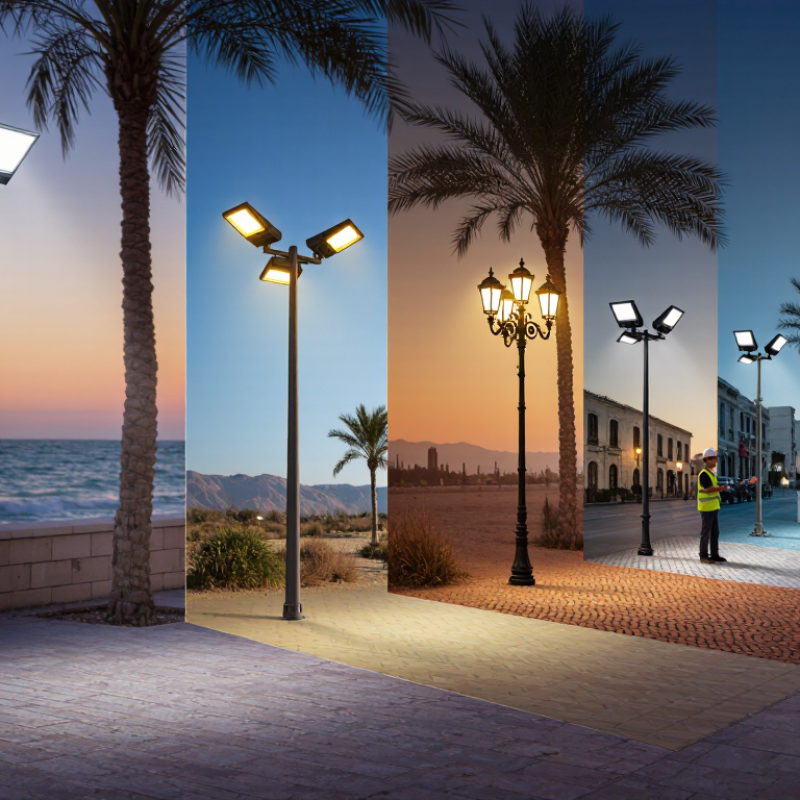
How to Choose Post Lighting for Global Projects in 2026?

Define Roadway Classes with CIE 115: 0.3–2 cd/m² Luminance Targets

For global roadway projects in 2026, post lighting should begin with the road, not the pole. CIE 115 offers a practical basis for defining roadway classes through maintained luminance. Typical targets range from 0.3 to 2 cd/m², depending on traffic, speed, road function, and surrounding conditions. The lower end may suit quieter roads. Higher values support demanding routes with greater visual complexity. These values describe the pavement’s maintained brightness, not the lamp’s initial output. That distinction matters.

A credible assessment starts with classification data. Record carriageway width, lane arrangement, conflict areas, pedestrian activity, weather exposure, and background brightness. Then calculate average luminance, overall uniformity, longitudinal uniformity, and glare. A 1 cd/m² target is not automatically safer than 0.5 cd/m². Excess light can reduce contrast, disturb residents, and waste energy. The selected class should also reflect maintenance conditions, because dirt and ageing reduce performance over time.

I would verify the model with site measurements after installation. Check dark zones near junctions, curves, signs, and crossings. Small errors often appear there. A first design can still be wrong. A system may pass calculation and feel uneven to drivers. That is a useful warning. Local regulations may modify CIE-based decisions, especially for pedestrian zones or heritage streets. Keep assumptions, photometric data, calculations, and commissioning results together. Reliable documentation lets another engineer challenge the choice and improve it.

Benchmark DOE SSL LEDs at 120+ lm/W and 50,000-Hour L70 Life

Choosing post lighting for global projects in 2026 requires more than comparing wattage. DOE SSL benchmarks can provide a useful starting point. Target LED systems delivering 120+ lumens per watt under documented test conditions. Also check the L70 rating, preferably 50,000 hours or more. L70 means the light output may decline to 70 percent of its initial level. It does not mean the fixture will fail at that hour.

Site conditions can change the result. A coastal walkway needs strong corrosion resistance. A cold logistics yard may require different driver performance. Check operating temperature, surge protection, optics, glare control, and maintenance access. Ask for independent photometric data, thermal testing, and clear warranty terms. Local electrical requirements and certification rules must also be verified before procurement. A neat spreadsheet can still mislead.

Tips: Compare delivered lumens, not just LED chip efficiency. Review lighting simulations at the actual mounting height. Confirm uniformity around entrances, paths, and vehicle areas. Measure color consistency between batches. Keep controls simple where maintenance teams have limited training. I would not treat 120 lm/W as a universal answer. Higher efficacy can reduce energy use, but poor optics may create dark patches. In real projects, a slightly less efficient fixture may perform better. That trade-off deserves honest review.

Specify IEC 60529 IP65–IP66 and IEC 62262 IK08–IK10 Protection

How to Choose Post Lighting for Global Projects in 2026?

Outdoor post lighting now faces dust, rain, cleaning jets, coastal salt, and accidental impact. The International Energy Agency reports that lighting uses about 15% of global electricity. Efficient equipment matters, but protection ratings often decide service life.

For exposed projects, specify IEC 60529 IP65 as a baseline. IP65 requires dust-tight construction and protection against water jets. IP66 adds stronger water-jet protection, making it more suitable for severe weather and frequent maintenance washing.

Impact protection also deserves precise attention. Under IEC 62262, IK08 withstands 5 joules of impact energy. IK10 withstands 20 joules. That difference is meaningful near pedestrian routes, parking areas, schools, and transport facilities.

The Global Status Report for Buildings and Construction continues to highlight the importance of resilient, efficient building infrastructure. Yet a high rating alone is not enough. Check mounting height, diffuser material, fasteners, drainage, and cable entries.

Real projects are messier. A laboratory pass can still fail after years of ultraviolet exposure or salt mist. I would request test reports, installation limits, and maintenance instructions before approval.

IP66 may be excessive in a sheltered courtyard, while IP65 may be too weak beside industrial washdown zones. Specify the rating with the environment, not in isolation. Suppliers should also confirm whether IK testing covers the complete assembled luminaire, not only its housing.

Calculate Spacing, Uniformity, and Glare Using IES RP-8 Metrics

Choosing post lighting for global projects starts with measurable performance, not visual appearance alone. IES RP-8 provides a practical framework for checking illuminance, uniformity, and glare. Record the road width, pole height, mounting position, surface reflectance, and maintenance factor before modeling. Small input errors can change the result.

Spacing should be tested with photometric software using the intended luminaire distribution. Begin with a trial spacing based on mounting height, then review the calculated average maintained illuminance. Check uniformity as the selected minimum-to-average or average-to-minimum ratio, and state the definition clearly in project documents. A layout may meet average levels yet leave dark patches between posts. Walkway edges and intersections deserve separate attention.

Glare needs equal care. Review disability glare through veiling luminance or Threshold Increment, where the applicable roadway class requires it. Shielding, aiming, mounting height, and observer position can change discomfort significantly. I have seen a clean computer grid feel harsh during an evening site review. The spreadsheet was correct, but the assumptions were too neat. Recheck results for wet pavement, aging output, different driving directions, and local viewing conditions. Global projects need local verification, because RP-8 metrics guide design but cannot replace field judgment.

Verify IEC 60598-2-3 Compliance and EN 13201 Energy Performance

Choosing post lighting for global projects starts with verifiable compliance, not appearance.

In global projects, compliance should be checked before photometric optimization. IEC 60598-2-3 covers luminaires for road and street lighting applications. Request current test reports from qualified laboratories. Review ingress protection, impact resistance, wiring spaces, thermal behavior, and mechanical mounting.

A polished datasheet is not proof. I have seen projects stall because certificates covered a similar, but different, luminaire. That gap is easy to miss.

EN 13201 focuses on lighting performance and energy use. Select the correct lighting class for roads, paths, or public areas. Calculate maintained illuminance, uniformity, glare, and energy performance indicators.

Do not compare wattage alone. A lower-power fitting can still fail uniformity targets. Check dimming schedules, control logic, maintenance factors, and expected operating hours. EN 13201-5 can support energy comparisons through standardized indicators.

For 2026 procurement, request photometric files, installation assumptions, and independent calculations. Confirm the referenced edition and local adoption requirements. Authorities may interpret regional rules differently.

My early assessments trusted calculated savings too much. Field conditions changed the result. Leave room for site measurements after installation, especially where mounting heights, dust, or nearby trees differ from the design model.

FAQS

What should be defined before selecting roadway lighting posts?

Define the roadway class first. Consider traffic, speed, road function, pedestrians, weather, and background brightness.

What does maintained luminance mean?

It describes pavement brightness during service. It includes dirt, ageing, and reduced output over time.

Are higher luminance levels always safer?

Not always. Excess light can reduce contrast, disturb residents, and increase energy use.

Which measurements should a lighting assessment include?

Record average luminance, overall uniformity, longitudinal uniformity, and glare. Check junctions, curves, signs, and crossings.

How should post spacing be tested?

Model spacing with photometric software and the intended light distribution. Review average maintained illuminance and dark areas.

Can a layout pass calculations but still feel uncomfortable?

Yes. A clean computer grid may feel harsh at night. Field review can reveal glare or uneven brightness.

What site details affect lighting calculations?

Record road width, pole height, mounting position, surface reflectance, and maintenance factor. Small errors matter.

How should compliance documents be checked?

Request current laboratory reports and photometric files. Verify protection, impact resistance, wiring space, thermal behavior, and mounting.

How should energy performance be compared?

Compare maintained performance, uniformity, glare, controls, operating hours, and energy indicators. Wattage alone is insufficient.

What should happen after installation?

Measure the installed system. Recheck wet pavement, dust, nearby trees, mounting differences, and different driving directions. Some assumptions may fail.

Conclusion

Choosing Post Lighing for global projects in 2026 requires a structured approach that balances safety, visibility, durability, and energy performance. Begin by classifying roadways according to CIE 115 and selecting suitable luminance targets, typically ranging from 0.3 to 2 cd/m². Evaluate LED systems against DOE SSL benchmarks of at least 120 lm/W and a rated L70 lifetime of 50,000 hours or more to support long-term efficiency and maintenance planning.

Environmental protection is equally important. Specify equipment with IEC 60529 IP65–IP66 ratings and IEC 62262 IK08–IK10 impact resistance for demanding outdoor conditions. Use IES RP-8 metrics to calculate pole spacing, average illumination, uniformity, and glare before installation. Finally, verify compliance with IEC 60598-2-3 and assess energy performance according to EN 13201. This standards-based process helps project teams create reliable, efficient, and adaptable lighting designs for different climates, roadway types, and regulatory environments.


Isabella

Isabella

Isabella is a dedicated marketing professional with a sharp focus on driving brand growth and engagement through strategic content creation. With an extensive background in digital marketing, she combines her passion for storytelling with her keen understanding of industry trends to deliver......