The 2026 lighting market will reward buyers who balance visual appeal, efficiency, and installation reliability. Grand View Research valued the global lighting market at USD 115.65 billion in 2022, with continued growth expected through 2030. Its smart lighting research also identifies connected controls as a fast-growing segment. These figures do not measure Hanging Lamp sales alone. They provide useful market direction, not certainty.
Randall Whitehead, a respected lighting designer and author, is widely associated with the phrase, “Lighting is the jewelry of architecture.” That idea remains practical in 2026. A ribbed glass pendant can soften a restaurant counter, while a black metal dome can focus light above a kitchen island. Woven rattan adds warmth, but it may require careful dusting and moisture control. Small details matter.
This guide examines the top Hanging Lamp types for global buyers, including minimalist pendants, cluster lights, linear fixtures, smart models, and sustainable material designs. Fortune Business Insights reports strong growth in the broader lighting fixtures market, supported by renovation, hospitality, and energy-efficiency demand. Still, forecasts are not promises. A popular style can fail when its cable length, socket type, dimming system, or mounting hardware does not match local conditions.
Reliable purchasing requires more than attractive product images. Check material consistency, heat management, electrical documentation, packaging strength, and replacement-part access. Certifications should suit the destination market. Even experienced buyers can overlook one detail. This comparison aims to make those decisions clearer, while admitting that no single Hanging Lamp suits every room, climate, or budget.
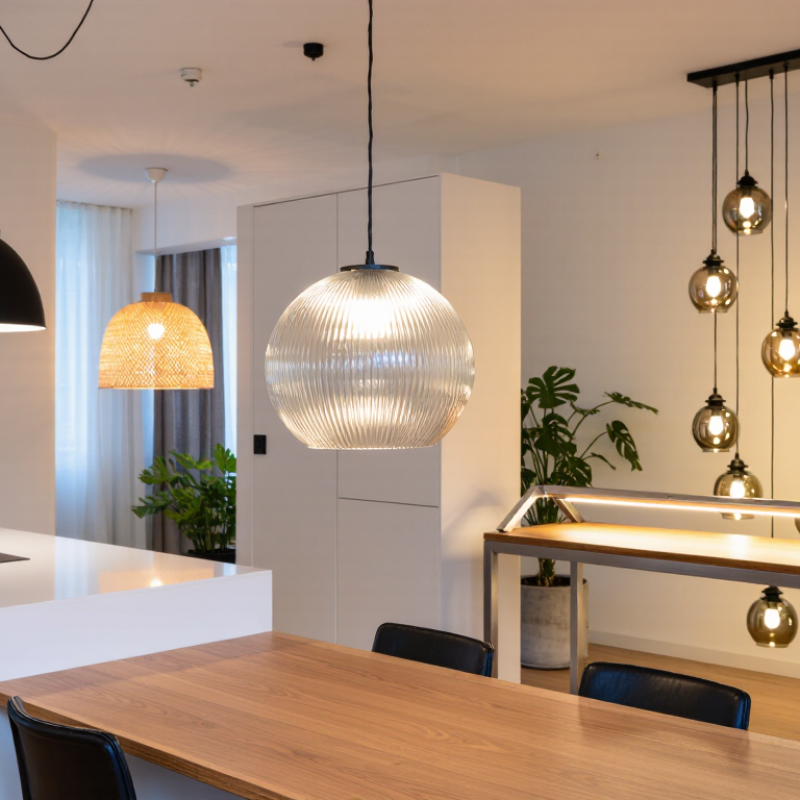
Hanging lamps are ceiling-mounted lighting fixtures suspended by a cord, rod, chain, or adjustable cable. Their defining feature is the visible drop from the ceiling to the light source. Unlike flush lights, they create a lower visual focus and can shape how people experience a room. In hotel dining areas, a 70-centimeter drop may feel balanced, while a lower fixture could interrupt sightlines across a table.
Global buyers usually classify hanging lamps by suspension method, shade structure, light source, and application. Pendant lamps often use one shade and one suspension point. Multi-light fixtures group several shades on a central frame or branching structure. Linear hanging lamps stretch across dining tables, counters, or workstations. Adjustable cable systems support changing ceiling heights and installation layouts. Classification is not always perfectly consistent.
Shade materials also affect performance. Glass spreads light smoothly, while metal directs it downward and creates sharper shadows. Fabric softens glare but may require more careful cleaning. Wood and woven fibers add texture, though natural variation can affect color matching. LED modules may reduce maintenance, but replacement details should be checked before purchase. A reliable specification sheet should state dimensions, net weight, input voltage, color temperature, dimming compatibility, cable length, and installation requirements.
In my experience, buyers sometimes choose by appearance first. That can create problems later. A large fixture may look impressive in a showroom but feel crowded above a small table. Sample measurements, ceiling height, and local electrical requirements deserve equal attention. Availability of replacement parts should also be confirmed.
Common types include pendant, globe, drum, lantern, cluster, and linear lamps. Each creates a different lighting effect.
Pendant lamps suit kitchen islands, bedside corners, and small dining tables. Their single shade creates a clear visual focus.
Check the ceiling height and walking clearance first. Compare the lamp with the table, not only the room.Measure twice.
Globe shades spread softer light. Drum shades create a calmer atmosphere. Lantern designs add architectural character to entrances and covered outdoor areas.
Cluster lamps suit stairwells and tall dining tables. Linear lamps work well above long tables and work counters.Too much detail can feel noisy.
Glass shows dust quickly and needs frequent cleaning. Fabric reduces glare but requires careful maintenance and gentle handling.
Check rated voltage, frequency, socket type, driver details, and dimming compatibility. Markets may use 120V or 220–240V systems.A wrong match may cause flickering.
Request dimensions, wiring diagrams, packing photos, mounting details, and installation instructions. Confirm ceiling-box capacity, grounding, and cable length.Small omissions become expensive problems.
Check the appropriate IP rating instead of judging appearance. Also confirm ventilation space around the driver and local safety requirements.Looks can mislead.
No. Consider glare, heat, cleaning access, daily use, and replacement parts. I have seen attractive lamps feel harsh at eye level.My judgment can be imperfect.
In 2026, a Hanging Lamp is defined as a ceiling-mounted light fixture suspended by a cord, rod, chain, or adjustable support. Common classifications include single pendants, multi-light clusters, linear hanging fixtures, adjustable designs, and decorative statement lamps. Buyers can choose from materials such as glass, metal, wood, fabric, and sustainable composites, while shapes range from globes and cones to geometric and sculptural forms. Light sources may include LED modules, replaceable bulbs, dimmable systems, and different color temperatures for varied atmospheres.
Selecting the right Hanging Lamp depends on the room’s size, ceiling height, furniture layout, and lighting purpose. Compact pendants suit bedrooms or entryways, while linear or multi-light models work well above dining tables, kitchen islands, and work areas. Global buyers should confirm voltage, frequency, socket compatibility, safety certifications, cable length, ceiling support, and installation requirements before purchasing. Careful attention to these factors helps ensure reliable performance, safe installation, and a suitable lighting experience across different markets.

 Austar